miCube V0.1: first tests

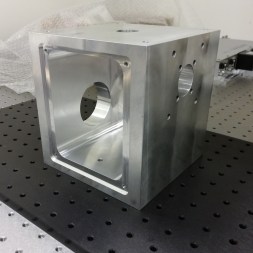
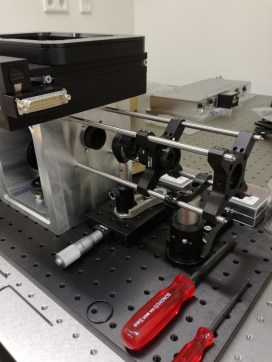
We finally managed to perform some test experiments and it is looking very promising! We tracked small fluorescent quantum dots (< 5 nm diameter) diffusing in water (20% glycerol) and we were happy to learn that even for such a demanding application new sCMOS-based cameras are doing just fine. Here a picture of the current assembly. More soon!

micubeassembled

News: Welcome to Jan Groen…

…who joins the group for his MSc thesis. In collaboration with the group of Stan Brouns (now Delft, previously WUR) he will enzymatically modify DNA to allow the labelling with fluorescent dyes and then image the labelled DNA in vivo and in vitro using super-resolution microscopy.

Publication: Probing the conformational landscape of DNA polymerases using diffusion-based single-molecule FRET

J. Hohlbein and A.N. Kapanidis, Methods in Enzymology: Single-molecule Enzymology Part A & B, 581, 353-378, 2016, [link]

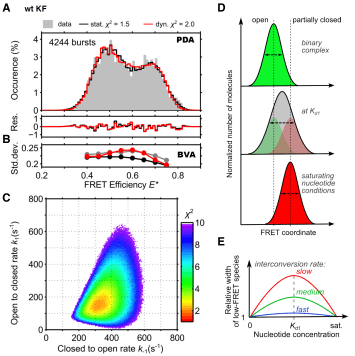
Monitoring conformationalchanges in DNA polymerases using single-molecule Förster resonance energy transfer (smFRET) has provided new tools for studying fidelity-related mechanisms that promote the rejection of incorrect nucleotides before DNA synthesis. In addition to the previously known open and the closed conformations of DNA polymerases, our smFRET assays utilising doubly labelled variants of E. coli DNA polymerase I were pivotal in identifying and characterising a partially-closed conformation as a primary checkpoint for nucleotide selection. Here, we provide a comprehensive overview of the methods we used for the conformational analysis of wild-type DNA polymerase and some of its low-fidelity derivatives; these methods include strategies for protein labelling and our procedures for solution-based single-molecule fluorescence data acquisition and data analysis. We also discuss alternative single-molecule fluorescence strategies for analysing the conformations of DNA polymerases in vitro and in vivo.

2016_Hohlbein_CH0030_Fig003_Kapanidis_v1_Orig

Publication: Fluorescence resonance energy transfer and protein-induced fluorescence enhancement as synergetic multi-scale molecular rulers

E. Ploetz, E. Lerner, F. Husada, M. Roelfs, S. Chung, J. Hohlbein, S. Weiss, T. Cordes, Scientific Reports, 6, 33257 , 2016, [link]

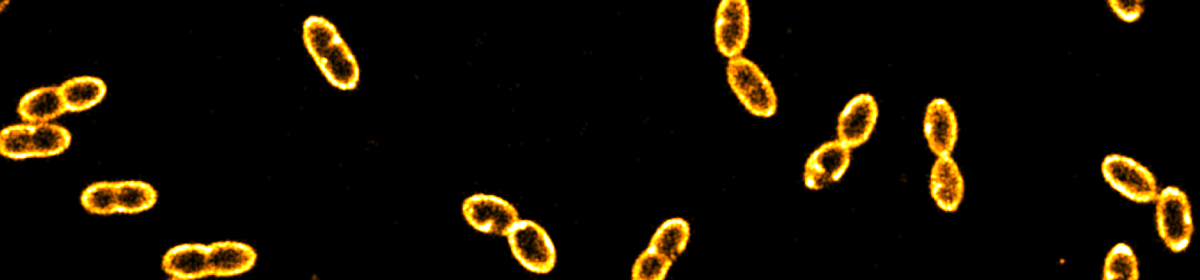
Advanced microscopy methods allow obtaining information on (dynamic) conformational changes in biomolecules via measuring a single molecular distance in the structure. It is, however, extremely challenging to capture the full depth of a three-dimensional biochemical state, binding-related structural changes or conformational cross-talk in multi-protein complexes using one-dimensional assays. In this paper we address this fundamental problem by extending the standard molecular ruler based on Förster resonance energy transfer (FRET) into a two-dimensional assay via its combination with protein-induced fluorescence enhancement (PIFE). We show that donor brightness (via PIFE) and energy transfer efficiency (via FRET) can simultaneously report on e.g., the conformational state of dsDNA following its interaction with unlabelled proteins (BamHI, EcoRV, T7 DNA polymerase gp5/trx). The PIFE-FRET assay uses established labelling protocols and single molecule fluorescence detection schemes (alternating-laser excitation, ALEX). Besides quantitative studies of PIFE and FRET ruler characteristics, we outline possible applications of ALEX-based PIFE-FRET for single-molecule studies with diffusing and immobilized molecules. Finally, we study transcription initiation and scrunching of E. coli RNA-polymerase with PIFE-FRET and provide direct evidence for the physical presence and vicinity of the polymerase that causes structural changes and scrunching of the transcriptional DNA bubble.

2016_Ploetz

News: VLAG proposal granted

Good news! Our proposal “Probing submicron anisotropic food structures using single-nanoparticle diffusometry” has been granted by the Graduate School VLAG [link] allowing us to hire a new PhD student.

In close collaboration with Prof. John van Duyhhoven (Laboratory of Biophysics, Wageningen), Prof. Aldrik Velders (Laboratory of BioNanoTechnology, Wageningen) and Prof. Atze Jan van der Goot (Laboratory of Food Process Engineering, Wageningen), we aim to develop and utilise fluorescence-based assays to study scale-dependent structural anisotropy in biopolymeric gels and food materials. Building on our broad expertise on single-particle tracking and imaging, we hope to establish single-molecule techniques as a new toolkit in food-related research.

Introducing miCube V0.1: Rethinking modular fluorescence microscopy

Update: Follow the link or Twitter (#miCube) for the lastest information.

Fluorescence microscopy is an extremely powerful and versatile technique contributing to many areas of the life sciences. Especially variants featuring the ability to monitor single-molecule fluorescence, however, require sophisticated instrumentation that is either very expensive when bought commercially (>> 100 kEuro) or demands extensive expertise in optics and engineering.

Here we present an open and modular hardware framework aiming for

  • cost effectiveness: build your own starting at 20k Euro (~100 kEuro for state of the art capabilities)
  • modularity: all parts can be accessed and replaced by the user
  • simplicity: set up the microscope in a few hours without prior knowledge
  • customizability: confocal or widefield/TIRF microscopy,…
  • openness: part lists and drawings will be made available
  • stability and throughput: minimizing drift and utilise well plate scanners

Interested? Drop me a line. We are currently working together with several academic labs to bring their ideas to life and develop the miCube concept further.

CompleteSetup

For a similar concept, please also visit http://wosmic.org/.

News: EPS proposal granted

Good news! Our proposal “Illuminating plant hormone responses at the single-molecule level” has been granted by the Graduate School Experimental Plant Sciences [link].

In close collaboration with Prof. Dolf Weijers from the Laboratory of Biochemistry (Wageningen), we aim to develop and utilise new fluorescence-based assays to quantify inter- and intra-molecular interactions in the auxin mediated signalling pathway. By applying techniques such as single-molecule Förster resonance energy transfer (smFRET), we will characterise the binding kinetics of various ARF-DBD proteins to DNA whilst monitoring structural changes of the DNA and the associated proteins.