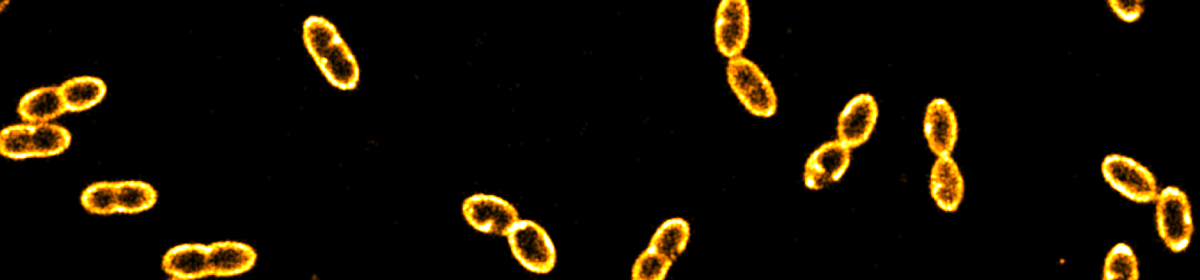
J. Hohlbein, T.D. Craggs, T. Cordes, Chemical Society Reviews, 43, 1156-1171, 2014, [link]
The alternating-laser excitation (ALEX) 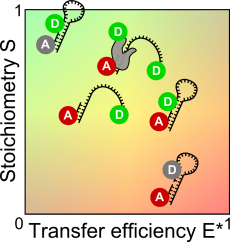 scheme continues to expand the possibilities of fluorescence-based assays to study biological entities and interactions. Especially the combination of ALEX and single-molecule Förster Resonance Energy Transfer (smFRET) has been very successful as ALEX enables the sorting of fluorescently labelled species based on the number and type of fluorophores present. ALEX also provides a convenient way of accessing the correction factors necessary for determining accurate molecular distances. Here, we provide a comprehensive overview of the concept and current applications of ALEX and we explicitly discuss how to obtain fully corrected distance information across the entire FRET range. We also present new ideas for applications of ALEX which will push the limits of smFRET-based experiments in terms of temporal and spatial resolution for the study of complex biological systems.

 ymerases depends on conformational changes that promote the rejection of incorrect nucleotides before phosphoryl transfer. Here, we combine single-molecule FRET with the use of DNA polymerase I and various fidelity mutants to highlight mechanisms by which active-site side chains influence the conformational transitions and free-energy landscape that underlie fidelity decisions in DNA synthesis. Ternary complexes of high fidelity derivatives with complementary dNTPs adopt mainly a fully closed conformation, whereas a conformation with a FRET value between those of open and closed is sparsely populated. This intermediate-FRET state, which we attribute to a partially closed conformation, is also predominant in ternary complexes with incorrect nucleotides and, strikingly, in most ternary complexes of low-fidelity derivatives for both correct and incorrect nucleotides. The mutator phenotype of the low-fidelity derivatives correlates well with reduced affinity for complementary dNTPs and highlights the partially closed conformation as a primary checkpoint for nucleotide selection.
 student in the van Amerongen group)! Shazia will take over some of Andy’s projects, who left the group to pursue new endeavours. Thanks to Andy’s work in the last three months, we are now able to detect single fluorescent molecules on our microscope. Hooray!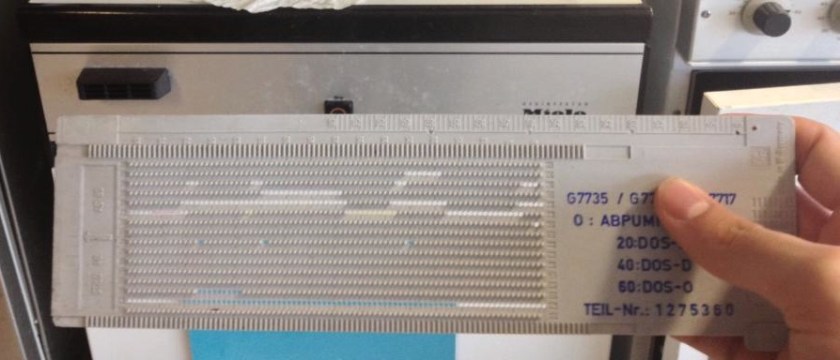
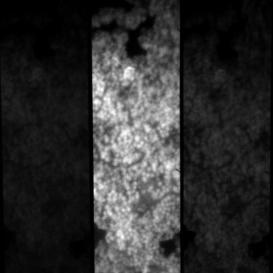 evening, we proudly present our first image taken with the new setup. Nothing very interesting, just some aggregated, fluorescent latex-beads on a cover slip surface imaged into blue, green and red detection channels of an emCCD camera (after excitation with a green laser). A big thank you goes to John for the laser control software!
 Hohlbein lab