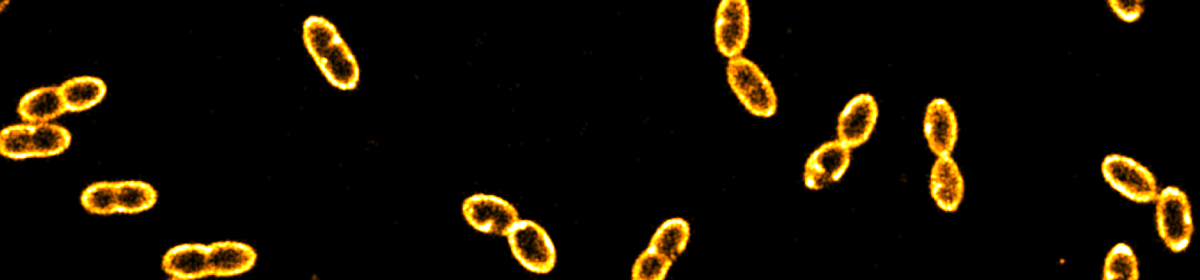
…who joined our lab for his Bachelor thesis. In cooperation with the Laboratory of Biochemistry (Prof. Dr. Dolf Weijers), he will study transcriptional regulators on the single-molecule level.
Publication: Camera-based single-molecule FRET detection with improved time resolution
S. Farooq and J. Hohlbein, Physical Chemistry Chemical Physics, 17, 27862, 2015, [link], open access

The achievable time resolution of camera-based single-molecule detection is often limited by the frame rate of the camera. Especially in experiments utilizing single-molecule Förster resonance energy transfer (smFRET) to probe conformational dynamics of biomolecules, increasing the frame rate by either pixel-binning or cropping the field of view decreases the number of molecules that can be monitored simultaneously. Here, we present a generalised excitation scheme termed stroboscopic alternating-laser excitation (sALEX) that significantly improves the time resolution without sacrificing highly parallelised detection in total internal reflection fluorescence (TIRF) microscopy. In addition, we adapt a technique known from diffusion-based confocal microscopy to analyse the complex shape of FRET efficiency histograms. We apply both sALEX and dynamic probability distribution analysis (dPDA) to resolve conformational dynamics of interconverting DNA hairpins in the millisecond time range.
Publication: Real-time single-molecule studies of the motions of DNA polymerase fingers illuminate DNA synthesis mechanisms
G.W. Evans, J. Hohlbein, T. Craggs, L. Aigrain and A.N. Kapanidis, Nucleic Acids Research, 43, 5998-6008, 2015, [link], open access
DNA polymerases maintain geno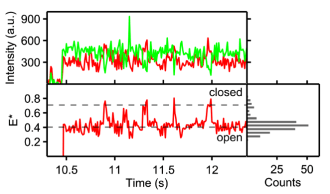 mic integrity by copying DNA with high fidelity. A conformational change important for fidelity is the motion of the polymerase fingers subdomain from an open to a closed conformation upon binding of a complementary
nucleotide. We previously employed intraprotein single-molecule FRET on diffusing molecules to observe fingers conformations in polymerase–DNA complexes. Here, we used the same FRET ruler on surface-immobilized complexes to observe fingers-opening and closing of individual polymerase molecules in real time. Our results revealed the presence of intrinsic dynamics in the binary complex, characterized by slow fingers-closing and fast fingers-opening. When binary complexes were incubated with increasing concentrations of complementary nucleotide, the fingers-closing rate increased, strongly supporting an induced-fit model for nucleotide recognition. Meanwhile, the opening
rate in ternary complexes with complementary nucleotide was 6 s^-1, much slower than either fingers closing or the rate-limiting step in the forward direction; this rate balance ensures that, after nucleotide binding and fingers-closing, nucleotide incorporation is overwhelmingly likely to occur. Our results for ternary complexes with a non- complementary dNTP confirmed the presence of a state corresponding to partially closed fingers and suggested a radically different rate balance regarding fingers transitions, which allows polymerase to achieve high fidelity.
News: Welcome to Mattia Fontana…
…who joined our lab for his Master thesis. Mattia is a student at the University of Bologna and, supported by an Erasmus fellowship, he will spend six months in Wageningen to work on the combination of single-molecule detection and novel microfluidic devices.
News: Congratulations to Alejandro Montón…
…who successfully defended his PhD thesis titled “Structural and kinetic characterization of DNA polymerases I and III from Escherichia coli” at the Spanish College in Bologna.
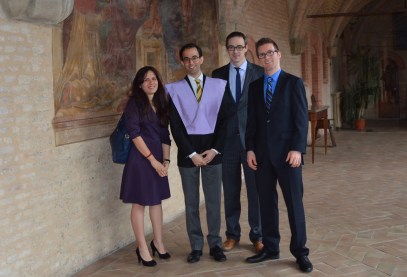
News: Welcome to Koen Tensen and Jochem Vink
Koen joined our group for his Bachelor thesis. He will study the dynamics of DNA hairpins using smFRET. Jochem Vink started his Master thesis in the group of Dr. Stan Brouns (Laboratory of Microbiology). Jochem will be a frequent user of our super-resolution microscope.
News: Welcome to Alejandro Montón…
…who is a PhD student at the University of Bologna working on DNA polymerases. He received an Erasmus fellowship to spend three months in our lab. He will study his favourite DNA polymerases using single-molecule FRET assays.
News: Marie Curie Career Integration Grant (CIG)
Good news! Our proposal “Nanofluidic devices for high-throughput single-molecule fluorescence detection (Nanofluidic-SMFD)” has been granted by the European Commission (FP7-PEOPLE-2013-CIG, #630992). The proposed work aims at utilising nanofluidic devices to overcome current limitations in single-molecule-fluorescence detection. Specifically, we are hoping to monitor enzymatic reactions such as DNA polymerisation in real time without immobilising any of the involved molecules to a surface as it is currently necessary. For this project, we will continue our collaboration with Klaus Mathwig (www.kmathwig.com).
Publication: Studying DNA-protein interactions with single-molecule Förster resonance energy transfer
S. Farooq, C. Fijen, J. Hohlbein, Protoplasma, SPECIAL ISSUE: NEW/EMERGING TECHNIQUES IN BIOLOGICAL MICROSCOPY, 251, 317-332, 2014 [link]
Single-molecule Förster 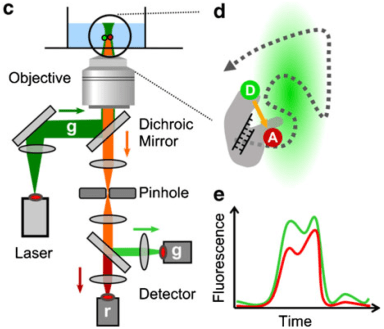 resonance energy transfer (smFRET) has emerged as a powerful tool for elucidating biological structure and mechanisms on the molecular level. Here, we focus on applications of smFRET to study interactions between DNA and enzymes such as DNA and RNA polymerases. SmFRET, used as a nanoscopic ruler, allows for the detection and precise characterisation of dynamic and rarely occurring events, which are otherwise averaged out in ensemble-based experiments. In this review, we will highlight some recent developments that provide new means of studying complex biological systems either by combining smFRET with force-based techniques or by using data obtained from smFRET experiments as constrains for computer-aided modelling.
Publication: A Novel Parallel Nanomixer for High-Throughput Single-Molecule Fluorescence Detection
K. Mathwig, S. Schlautmann, S. G. Lemay, J. Hohlbein, A Novel Parallel Nanomixer for High-Throughput Single-Molecule Fluorescence Detection, Proceedings of the 17th International Conference on Miniaturized Systems for Chemistry and Life Science, Freiburg, Germany, Oct. 27 – 31 (2013) 1385, [link]
This paper introduces a novel  fluidic device based on syringe-driven flow of fluorescent species through a parallel array of nanochannels, in which the geometrical confinement enables long observation times of non-immobilized molecules. Extremely low flow rates are achieved by operating the array of nanochannels in parallel with a larger microchannel. The addition of a second microfluidic inlet allows for mixing different species in a well-defined volume, enabling the study of irreversible reactions such as DNA synthesis in real-time using single-molecule fluorescence resonance energy transfer. Devices are fabricated in glass with the purpose of high-throughput single-molecule fluorescence detection.
 Hohlbein lab