B. Hellenkamp, S. Schmid, O. Doroshenko, O. Opanasyuk, R. Kühnemuth, S. Rezaei Adariani, B. Ambrose, M. Aznauryan, A. Barth, V. Birkedal, M.E. Bowen, H. Chen, T. Cordes, T. Eilert, C. Fijen, C. Gebhardt, M. Götz, G. Gouridis, E. Gratton, T. Ha, P. Hao, C.A. Hanke, A. Hartmann, J. Hendrix, L.L. Hildebrandt, V. Hirschfeld, J. Hohlbein, B.g Hua, C.G. Hübner, E. Kallis, A.N. Kapanidis, J.Y. Kim, G. Krainer, D.C. Lamb, N.K. Lee, E.A. Lemke, B. Levesque, M. Levitus, J.J. McCann, N. Naredi-Rainer, D. Nettels, T. Ngo, R. Qiu, N.C. Robb, C. Röcker, H. Sanabria, M. Schlierf, T. Schröder, B. Schuler, H. Seidel, L. Streit, J. Thurn, P. Tinnefeld, S. Tyagi, N. Vandenberk, A. Manuel Vera, K.R. Weninger, B. Wünsch, I.S. Yanez-Orozco, J. Michaelis, C.A.M. Seidel, T.D. Craggs, T. Hugel, Nature Methods, 15, 669, 2018, [link], preprint on arXiv: [link]
Single-molecule Förster resonance energytransfer (smFRET) is increasingly being used to determine distances, structures, and dynamics of biomolecules in vitro and in vivo. However, generalized protocols and FRET standards to ensure the reproducibility and accuracy of measurements of FRET efficiencies are currently lacking. Here we report the results of a comparative blind study in which 20 labs determined the FRET efficiencies (E) of several dye-labeled DNA duplexes. Using a unified, straightforward method, we obtained FRET efficiencies with s.d. between ± 0.02 and ± 0.05. We suggest experimental and computational procedures for converting FRET efficiencies into accurate distances, and discuss potential uncertainties in the experiment and the modeling. Our quantitative assessment of the reproducibility of intensity-based smFRET measurements and a unified correction procedure represents an important step toward the validation of distance networks, with the ultimate aim of achieving reliable structural models of biomolecular systems by smFRET-based hybrid methods.

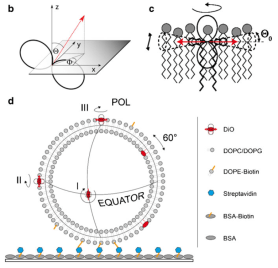 he method is based on the detection of single photons, it additionally allows for performing fluorescence correlation spectroscopy (FCS) as well as dynamical anisotropy measurements thereby providing access to fast orientational dynamics down to the nanosecond time scale. The 3D orientation is particularly interesting in non-isotropic environments such as lipid membranes, which are of great importance in biology. We used giant unilamellar vesicles (GUVs) labeled with fluorescent dyes down to a single molecule concentration as a model system for both, assessing the robustness of the orientation determination at different timescales and quantifying the associated errors. The vesicles provide a well-defined spherical surface, thus, the in cooperation of lipid dyes (DiO) represents a a wide range of dipole orientations. To complement our experimental data, we performed Monte Carlo simulations of the rotational dynamics of dipoles incorporated into lipid membranes. Our study offers a comprehensive view on the dye orientation behavior in a lipid membrane with high spatiotemporal resolution representing a six-dimensional fluorescence detection approach.
  Hohlbein lab