
J. Hohlbein and C.G. Hübner, Applied Physics Letters, 86, 121104, 2005, [link]
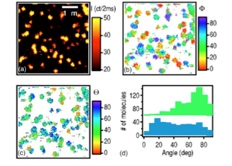 One of the unique features of single molecule absorption and emission is their anisotropy due to the well-defined transition dipole(s) for both processes allowing the determination of the molecule’s orientation. While polarization-resolved techniques are usually capable of detecting only a projection of the transition dipole, several methods have been proposed in order to determine the full three-dimensional orientation. Here, we report on a detection scheme that allows for a shot-noise limited determination of the emission dipole orientation utilizing an annular mirror, a polarizing beam splitter in conjunction with three detectors in a scanning confocal optical microscope.
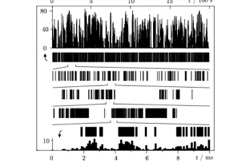 We report on fluorescence fluctuations of nanoparticles diffusing through a laser focus. Subject to an intensity threshold the fluorescence signal is transformed into time traces of on and off periods. The distribution functions of the experimental on and off times follow power laws t^-alpha over several orders of magnitude with exponents alpha equal 1.5-2. At long times the distribution functions cross over to exponential decays. For the interpretation of the experimental data a diffusion-reaction equation is proposed which covers both, the diffusion controlled recurrence and the photon statistics as the relevant processes.

